
Where Bulgaria meets balneo
Spa Holidays in Bulgaria's Thermal Towns
From mineral springs and thermal baths to spa hotels and free public pools — Bulgaria is Europe's best-value wellness escape, in your language.
Our mission
The honest guide to Bulgaria's thermal wellness
Bulgaria has more mineral springs than almost anywhere in Europe — yet for international travellers it remains a hidden corner of the wellness map. We gather the country's thermal towns, hotels and free public baths into one clear, multilingual resource, written like advice from a trusted local friend.
Where to go
Bulgaria's thermal map
From the Rhodope Mountains to the Roman springs of the Thracian plain, mineral water surfaces across the country. Explore the towns that have built a wellness tradition around it.
Why Bulgaria
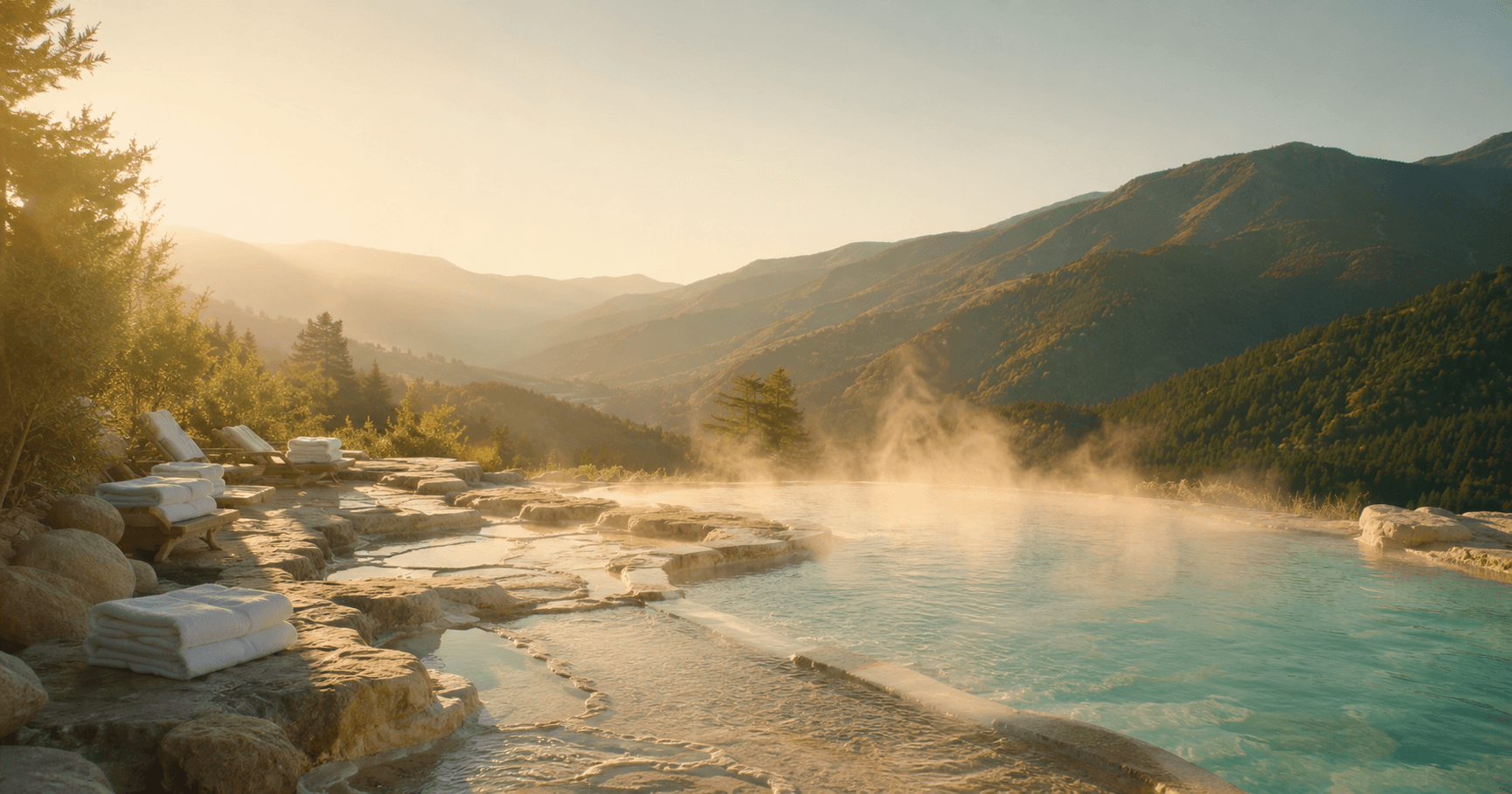
A 2,000-year balneo tradition, still remarkably affordable
Balneotherapy — the use of natural mineral water to treat and prevent illness — has been practised on Bulgarian soil since Thracian and Roman times. Today the country counts more than 600 springs, with waters rich in fluoride, silicon, sodium and radon.
What sets Bulgaria apart is value: comparable treatments and thermal hotels cost a fraction of those in Western or Central Europe, in settings ranging from pine-clad mountains to ancient Roman spa towns.
- 600+
- mineral springs
- 22–103°C
- water temperatures
- 2000+
- years of spa heritage
Destinations
Bulgaria's thermal & spa towns
In-depth guides to Bulgaria's leading thermal towns — their mineral springs, spa hotels, treatments and how to get there.

Sofia (Sofia City)
Bankya
15 springs
Bankya is Sofia's spa town — a leafy resort suburb on the city's western edge, just 17 km from the centre, long prized for gentle thermal water and clean mountain air. It is best known as Bulgaria's cardiovascular cure, a place people come to recover and rebuild after heart trouble. The heart cure Bankya's water is unusually mild — warm rather than hot, very weakly mineralised and softly alkaline — which, combined with the calm climate at the foot of Lyulin mountain, made it Bulgaria's leading cardiac-rehabilitation resort. The pace here is restorative by design. The mineral water — and what it's good for Around 15 natural springs surface at about 36.5 °C. The water is bicarbonate-sulphate-sodium, very weakly mineralised, alkaline (pH ~9–9.5), with a little silica (≈48 mg/L) — a profile often likened to the celebrated water of Vichy in France. It's used for drinking cures, baths and pool bathing — above all in cardiovascular and general rehabilitation. Treat this as background, not medical advice. A spa with royal-era grandeur Bankya took off in the early 20th century: the first public bath opened in 1906, and the grand Central Bath was completed in 1910 to a design by the Munich architect Karl Hocheder — so admired that it became known as the "Royal Bath." Now reopened after restoration, it offers a range of inexpensive balneo treatments, alongside the spa life of the hotels and modern pools. Where to stay Bankya has spa hotels and sanatoriums, several with cardiac and rehabilitation programmes, plus guesthouses for a quiet weekend from Sofia. Browse the hotels below; verify directly. Best time to visit Year-round — and uniquely easy, since it's a short hop from Sofia in any season. Combine your trip Bankya is effectively part of Sofia: combine a soak with the capital's sights, or walk the trails of Lyulin mountain on the doorstep. Two quiet monasteries are within easy reach — the Divotino (Divotinski) and Klisura (Klisurski) monasteries.

Rhodope Mountains (Smolyan Province)
Devin
6 springs
Devin is Bulgaria's mineral-water capital. The name is on bottles across the country, and the town that supplies it sits deep in the Rhodope Mountains, wrapped in forest, gorges and cave country. Alongside the famous drinking water, Devin is a quiet thermal-spa town with naturally hot, strikingly pure springs. The mineral water — and what it's good for Devin's thermal field was tapped by drilling between 1972 and 1982, at depths of 550–700 m. The town's six wells give water of 37–44 °C (main source ~42 °C): a sodium-bicarbonate, nitrogen and fluoride water, very weakly mineralised (0.23–0.37 g/L), strongly alkaline (pH ~9.4) and rich in silica, with a little radon. A few kilometres away the Beden deposit is much hotter (73.5–76 °C). The lightly mineralised bottled Devin water is valued for the digestive and urinary systems and, thanks to its fluoride, for dental health. Treat this as background, not medical advice. A Rhodope spa town Devin wears its spa life lightly — this is a place for forest air and quiet soaks rather than grand bath-houses. Spa hotels draw on the thermal water for mineral pools and balneo treatments, and the surrounding Rhodopes are some of the wildest, most beautiful in Bulgaria. Where to stay Devin has a small but solid set of spa hotels with mineral-water pools, plus guesthouses. Browse the hotels below; verify prices and treatments directly. Best time to visit Year-round. Summer and autumn are glorious for the gorges and caves; winter pairs the springs with skiing at nearby Pamporovo. Combine your trip Devin is the gateway to the Trigrad Gorge and the Devil's Throat Cave, the Yagodina Cave and the Buynovo Gorge — high above which the Orlovo Oko ("Eagle's Eye") viewing platform, one of Bulgaria's highest panoramic points (~1,563 m, reached by off-road jeep), opens a breathtaking Rhodope panorama. Add the picture-perfect village of Shiroka Laka; the Pamporovo ski resort is about 40 km away — an easy Rhodope ski-and-spa pairing.

Pirin / Blagoevgrad Province (near Bansko)
Dobrinishte
17 springs
Dobrinishte is where you ski and soak. This small town on the north-eastern slopes of the Pirin mountains, just 6 km from the Bansko ski resort, has 17 mineral springs and a tradition of outdoor thermal bathing — the perfect after-ski antidote, and a budget-friendly alternative to Bansko's prices. The mineral water — and what it's good for Dobrinishte's 17 springs run 30–43 °C along the riverbank. The water is a sulphate-sodium, fluoride and silica type, very weakly mineralised (0.29 g/L), alkaline (pH ~9.1), with a little radon — one source, the "Silver Spring," is notably rich in silver ions. It's used for the kidneys and urinary tract, stomach and liver, respiratory infections, detox from occupational toxins, and skin/wound healing. Treat this as background, not medical advice. The "Roman bath" and outdoor pools The town has bathed here since antiquity: a small 2-metre stone basin known as the "Roman bath" (Rimsko banche) was uncovered in 1966. Today the public mineral bath (built 1934, with gender-separated pools, very cheap) and several hotel complexes offer outdoor thermal pools against a mountain backdrop. Where to stay Dobrinishte has a growing set of spa hotels and resorts with outdoor mineral pools — a relaxed, better-value base than Bansko itself. Browse the hotels below; verify prices and treatments directly. Best time to visit Winter for ski-and-spa (Bansko's season runs December–April), and summer/autumn for hiking in Pirin straight from a thermal soak. Combine your trip You're on the doorstep of Bansko (6 km) and Pirin National Park (Vihren, the Banderitsa lakes), with the thermal village of Banya nearby. And Dobrinishte is the southern end of the famous railway — see "getting there."

Plovdiv Province
Hisarya
22 springs
Hisarya is Bulgaria's Roman spa town — and unusually, the spa and the history are the same story. People have come here to drink and bathe in the mineral water for nearly two thousand years, and the Romans liked it so much they walled the whole town. Today Hisarya combines 22 mineral sources (around 28–52 °C) with one of the best-preserved Roman sites in the country. A cure since Roman times — Diocletianopolis The Thracians settled here in the Bronze Age, but Rome turned Hisarya into a spa city. Around 135–136 AD Emperor Hadrian declared the thermal area imperial land and the first Roman baths were built; in 293 AD Emperor Diocletian granted the town city status — and, by tradition, came to be healed here — giving it the name Diocletianopolis. What survives is exceptional: Roman fortress walls 2,327 m long and up to 11 m high, enclosing a 30-hectare town, the monumental south gate locally nicknamed "the Camels" (Kamilite, up to 13 m), plus baths, streets, tombs and an amphitheatre — a National Archaeological Reserve since 1976. The later Ottoman name Hisar — "fortress" — simply names what was already there. The mineral water — and what it's good for Hisarya's water is best known as a drinking cure. Its 22 sources — sixteen working springs rising in two park groups, Momina Banya and Momina Salza, joined by drilled wells — are slightly mineralised, hydrocarbonate-sodium waters (with sulphate), weakly alkaline (pH ~8–9) and notably rich in fluoride (≈4–9 mg/L), silica and radon (highest at Momina Banya), with a faint hydrosulphide note. The water is used above all for the kidneys and urinary tract and for stomach, intestinal, liver and gallbladder complaints, plus joints, skin conditions, neuroses, post-stroke recovery and metabolic syndrome. You'll see people filling bottles at the public drinking pavilions — the bottled "Hisar" mineral water comes from here. Treat this as background, not medical advice. Where to stay Hisarya has a cluster of spa hotels and medical-balneo sanatoriums set among the parks and Roman walls, from four-star spas to simple guesthouses — several geared to longer therapeutic stays. Browse the hotels in Hisarya below; verify prices and treatment programmes directly. Best time to visit Hisarya is a year-round resort. Spring and autumn are especially pleasant for combining the springs with walks among the ruins; summer pairs well with the outdoor pools and the nearby wine country. Combine your trip Hisarya sits just 40 km north of Plovdiv, so it's easy to pair with Plovdiv's old town and Roman theatre. To the west, the Starosel Thracian temple complex and the surrounding wine cellars make a fine day out, with the Sredna Gora hills for walking.

Kyustendil Province (SW Bulgaria)
Kyustendil
40 springs
Kyustendil is one of Bulgaria's oldest — and least commercialised — spa towns. Set in a fruit- growing valley near the Macedonian and Serbian borders, it has been a bathing town since antiquity, when the Romans built Pautalia around its hot springs. For travellers who want thermal water with real history and few crowds, this is the place. Roman Pautalia The Romans developed Pautalia under Emperor Trajan (98–117 AD), and its thermae covered around 1,000 m² with sophisticated hypocaust under-floor heating — the second-largest Roman bath complex in Bulgaria, after Odessus (Varna). The town was later the Byzantine and medieval Velbazhd (famous for the 1330 battle), then renamed Kyustendil under Ottoman rule, after the feudal lord Konstantin Dragash. The mineral water — and what it's good for Kyustendil is generously watered: around 40 natural springs plus a dozen wells, at 26–76 °C. The water is a hydrocarbonate-sulphate-sodium type, fresh (≤1 g/L), moderately alkaline (pH ~8.5–9), with fluoride (~9 mg/L), hydrogen sulphide (9–11 mg/L) and silica. It's used for drinking cures, baths, pools, irrigation and inhalation therapy — for musculoskeletal, gynaecological and respiratory complaints. Treat this as background, not medical advice. Where to stay Kyustendil has spa hotels old and new, including the well-known Hisarlaka area above town. Browse the hotels below; verify prices and treatments directly. Best time to visit Year-round, with spring blossom (this is "the orchard of Bulgaria") and golden autumn especially lovely. Combine your trip Climb to the Hisarlaka fortress and forest park above town, see the medieval Pirgova Tower and the famous Vladimir Dimitrov–Maistora art gallery, hike the Osogovo mountain, or detour to the rock-hewn frescoes of Zemen Monastery.

SW Rhodopes / Mesta valley (Blagoevgrad Province)
Ognyanovo
9 springs
Ognyanovo is the Rhodopes' open-air soak. This small spa village in the Mesta valley is best known for its outdoor mineral pools — steaming in the mountain air — and for being one of Bulgaria's most affordable thermal stops. It's a relaxed, scenic alternative to the bigger resorts. The outdoor mineral pools Ognyanovo's signature is the "Miroto" — small open-air thermal pools (traditionally separate men's and women's basins) fed straight from the springs. Soaking outdoors here, ringed by mountains, is the whole point of the village. The mineral water — and what it's good for Nine sources (seven natural springs plus two boreholes) give water of 36–43 °C, with a combined flow of about 25 L/s. It's a hydrocarbonate-sulphate-sodium water, very weakly mineralised (~0.21 g/L), alkaline (pH ~9), with fluoride (~5.5 mg/L) and silica (no radon). It's used for the musculoskeletal system, neurological, gynaecological and urological conditions. Designated a balneological resort back in 1963. Treat this as background, not medical advice. Where to stay Ognyanovo has a cluster of good-value spa hotels with mineral pools, plus guesthouses. Browse the hotels below; verify prices and treatments directly. Best time to visit Year-round — the outdoor pools are most magical in cold, clear weather, with steam rising against the mountains. Combine your trip Ognyanovo sits near Gotse Delchev (~15 km) and the Garmen area: visit the Roman ruins of Nicopolis ad Nestum, and the beautiful stone heritage villages of Kovachevitsa and Leshten. The Bansko ski resort is roughly 50 km away for a ski-and-spa combination.

Pirin / Blagoevgrad Province (SW Bulgaria)
Sandanski
16 springs
Sandanski is Bulgaria's warmest town — and its most famous climatic cure. Tucked into the southern foothills of the Pirin mountains near the Greek border, it enjoys a Mediterranean microclimate that draws people with asthma and respiratory conditions from across Europe, on top of a generous supply of hot mineral water. The climate cure — asthma & respiratory health What sets Sandanski apart isn't only the water: it's the air. Mild winters, low humidity, plenty of sunshine and low airborne allergens make it one of Europe's recognised destinations for bronchial asthma and respiratory rehabilitation — a "climatic" therapy as much as a balneo one. The mineral water — and what it's good for Sandanski's springs are genuinely hot: 39–83 °C, from 16 natural sources plus two deep boreholes (440 m and 1,016 m), with a combined flow of about 21 L/s. The water is a sulphate-bicarbonate- sodium type, weakly mineralised (0.5–0.7 g/L), near-neutral (pH ~7.8), notably silica-rich (≈372 mg/L) with fluoride (~6 mg/L). It's used for the musculoskeletal system and general balneo programmes alongside the climatic respiratory treatment. Treat this as background, not medical advice. Roman roots Sandanski stands on ancient Parthicopolis, with Roman thermal baths and mosaics; it was later known as Sveti Vrach ("the Holy Healer," after Saints Cosmas and Damian) before taking its present name. The town's huge riverside park is among the largest in Bulgaria. Where to stay Sandanski has full-service spa hotels and balneo-medical hotels, several with respiratory and rehabilitation programmes. Browse the hotels below; verify prices and treatments directly. Best time to visit Year-round, but the mild shoulder seasons (autumn, early spring) are especially pleasant, and winters are gentle thanks to the microclimate. Combine your trip Sandanski pairs beautifully with the wine town and sandstone pyramids of Melnik (~20 km), the cliff-set Rozhen Monastery, Pirin National Park, and a short detour to Rupite (the hot springs and chapel linked to the prophetess Vanga). Thessaloniki (Greece) is about 130 km south.

Rila / Kyustendil Province
Sapareva Banya
15 springs
Sapareva Banya has continental Europe's only geyser — a column of 103 °C mineral water that shoots up to 18 metres into the air. It is the hottest mineral water in Bulgaria, and the little town at the foot of the Rila mountain has built its spa life around it. The geyser The geyser appeared in 1957, when a drilling crew tapped the super-heated water and it erupted skyward. Today it's a controlled borehole geyser in the town centre — released on a set schedule rather than at random — but the spectacle is real: a roaring 103 °C jet, wreathed in steam, unique on the European continent. (You watch it, you don't bathe in it — at that temperature the water has to be cooled first.) The mineral water — and what it's good for Across the town's sources the water ranges from about 31 °C to 103 °C. It is a hydrocarbonate-sulphate-sodium water, alkaline (pH ~9.3), weakly mineralised (~0.65 g/L), with a faint sulphur smell from hydrogen sulphide (15–20 mg/L), a high fluoride content (~17 mg/L) and dissolved silica. Local balneology centres and spa hotels use it for the musculoskeletal system, the peripheral nervous system, skin conditions (including psoriasis), and — per local sources — gynaecological, respiratory and detox programmes. As always, treat this as background, not medical advice. A cure with a Thracian name The Thracians knew these waters and called the place Germae — "hot." It was a noted bathing centre in Roman times too, so the modern spa town simply continues a habit two millennia old. Where to stay Sapareva Banya and the neighbouring village of Sapareva have a growing cluster of spa hotels with hot mineral pools, from boutique four-stars to family hotels. Browse the hotels below; verify prices and treatments directly. Best time to visit Year-round. The thermal pools are a joy in winter snow; summer and autumn are ideal for pairing the spa with the Rila mountains. The geyser performs in any season. Combine your trip This is one of Bulgaria's best spa-and-nature bases. The Rila Monastery (a UNESCO World Heritage site) is within easy reach, and the Panichishte gondola nearby climbs towards the spectacular Seven Rila Lakes — a classic day hike straight from a thermal soak.

NW Bulgaria / Stara Planina (Montana Province)
Varshets
6 springs
Varshets is one of Bulgaria's oldest and gentlest spa towns. Set at the foot of the western Stara Planina (Balkan mountains) in the country's quiet north-west, it has welcomed cure-seekers since the 19th century — and the Romans long before that, who knew it as "Medeka," meaning "hot, boiling water." The softest water in Bulgaria Varshets's calling card is the quality of its water, not its heat. Drawn from six springs and boreholes at 32–37 °C, it is a sulphate-bicarbonate-sodium water, very weakly mineralised (under 1 g/L), alkaline (pH ~8.5–9) with a little radon — and famously free of limescale, which makes it one of the softest, most pleasant drinking waters in the country. A heart-and-nerves cure Varshets specialises in cardiovascular disease and disorders of the nervous system (including recovery after stroke and ischaemic heart disease), alongside endocrine-metabolic, gastrointestinal and liver conditions, and skin problems such as trophic ulcers, neurodermatitis and chronic eczema. Treat this as background, not medical advice. A historic resort and the Sun Garden The modern resort grew through the 19th century (first mentioned 1848; established as a resort by 1879), and public mineral baths opened here in 1910 — among the earliest in Bulgaria — followed by the New Bath in 1930. In 1934 the town laid out its beloved Sun Garden (Slancheva Gradina), whose ray-shaped alleys of pale, light-reflecting stone and avenue of plane trees remain the heart of the resort. Where to stay Varshets has spa hotels and a sanatorium tradition, plus family guesthouses — a calm, good-value, family-friendly base. Browse the hotels below; verify prices and treatments directly. Best time to visit Year-round, with the Sun Garden at its best in late spring and autumn and the Balkan slopes inviting in summer. Combine your trip Varshets pairs with the mountain town of Berkovitsa, the Kom peak and western Stara Planina trails, and the scenic Petrohan Pass back towards Sofia — a restful corner of Bulgaria few foreign visitors reach.

Rhodope Mountains
Velingrad
90 springs
Velingrad is the spa capital of the Balkans — and the title is earned, not marketing. More than 90 mineral springs rise in and around this small town in the western Rhodope Mountains, with temperatures ranging from a gentle 28 °C to a near-scalding 91 °C (the hottest in the Kamenitsa district). Few places in Europe pack this much thermal water into one valley, which is exactly why Bulgarians have come here to "take the waters" for generations. A town built from three spa villages Modern Velingrad was formed in 1948 from three neighbouring villages — Chepino, Ladzhene and Kamenitsa — and each still has its own character and its own springs. Ladzhene is the spa heart, home to the grand bath-houses and the promenade; Kamenitsa and Chepino spread up the pine-clad slopes. You'll see the three names on hotels, springs and bus stops, so it helps to know them. Roman roots and an Italian-designed bath-house People have used these waters since antiquity: Roman water intakes and arches came to light when the landmark Sulphur Bath (Syarna Banya) was built in the Kamenitsa district. Commissioned under Tsar Ferdinand and designed by the Italian architect Luigi Pietri, it opened in 1920–21, modelled on the grand bath-houses of Karlovy Vary, and still stands as Velingrad's signature building. The town took its present name in 1948, after Vela Peeva, a local wartime partisan. The mineral water — and what it's good for Velingrad's springs are grouped in four deposits — Chepino, Ladzhene, Kamenitsa and Draginovo — with a combined flow of over 160 litres per second. Most are hyperthermal yet weakly mineralised (under 1 g/L), alkaline, sodium-bicarbonate-sulphate waters, notably rich in fluoride and silica, with radon in the Chepino springs. That variety is why the resort treats such a broad range of conditions: local balneology centres and spa hotels use the water for the musculoskeletal system, neurological disorders, high blood pressure, kidney and urological complaints, gynaecological conditions, and respiratory and digestive illness. Treat this as background, not medical advice — a doctor or balneologist should guide any therapeutic stay. Kleptuza — Bulgaria's biggest karst spring Not all of Velingrad's water is warm. On the right bank of the Chepinska River, by the Chepino quarter, the Kleptuza karst spring gushes up to roughly 1,200 litres of ice-cold water per second — the largest karst spring in the country — feeding two lakes ringed by a pleasant park. It's the town's free, year-round centrepiece and a lovely counterpoint to a hot mineral soak. Where to stay Velingrad has the densest concentration of spa hotels in Bulgaria, from five-star resorts with their own mineral water to modest family-run guesthouses. Browse the hotels in Velingrad below for mineral-water pools, balneo treatments and approximate prices — and verify rates directly, as they change seasonally. Best time to visit Velingrad is a year-round destination. The thermal hotels run in every season, and the mountain setting means crisp, clean air whatever the month. Winter is popular for warming soaks and is the natural time to combine a stay with skiing nearby; late spring and autumn are quietest and best value. Combine your trip Velingrad sits within easy reach of the Bansko–Dobrinishte ski area, making a ski-and-spa week genuinely practical. Closer to town, walk or cycle the forest trails around Kleptuza, ride the narrow-gauge railway through the Rhodopes, or detour to the Tsepina fortress and the Yundola meadows between Velingrad and Bansko.
Latest
From the journal
Guides, comparisons and practical advice for planning a thermal wellness trip to Bulgaria.

June 20, 2026
Best Thermal Spas in Europe: A Comparison by Water & Experience
Europe gave the world the word "spa" — from the Belgian town of Spa — and it remains the richest continent for thermal bathing, from Roman springs still plumbed for hot water to volcanic lagoons. The destinations below each do something distinctive. Rather than rank them, this guide looks at what's actually in the water, what it's used for, and how the great names compare — price included. Hungary — Budapest & Hévíz Budapest is the "City of Spas," built over a fault that feeds dozens of springs. The grand neo-baroque Széchenyi (one of Europe's largest bath complexes) and Art-Nouveau Gellért draw on calcium-magnesium-bicarbonate and sulphate waters up to about 76 °C, used mainly for joints and the musculoskeletal system. South-west of the capital, Lake Hévíz is the world's largest biologically active thermal lake — peat-mud and volcanic-fed, around 24 °C in winter and 35–38 °C in summer, carrying sulphur, carbon dioxide, magnesium, bicarbonate and a trace of radon, long used for arthritis and locomotor conditions. Czechia — Karlovy Vary & the spa triangle Karlovy Vary (Carlsbad) is the archetypal 19th-century spa town, built around colonnades and the Vřídlo (Sprudel) geyser, which jets to roughly 12 m at 72–73 °C. Its 12 active springs share one highly-mineralised sodium-bicarbonate-sulphate-chloride water (the "Glauber's salt" type), taken above all as a drinking cure for digestive, metabolic and liver/bile complaints — sipped from a spouted spa cup along the colonnade. With Mariánské Lázně and Františkovy Lázně it forms the Czech spa triangle, part of the UNESCO Great Spa Towns of Europe. Germany — Baden-Baden Baden-Baden's springs were first piped by the Romans (whose bath ruins survive) and revived as Europe's most elegant 19th-century resort. About a dozen springs deliver hot sodium-chloride (brine) thermal water up to ~68 °C, with a little radon, used for rheumatic and cardiovascular complaints. The draw here is the bathing ritual itself — the historic Friedrichsbad and the modern Caracalla Therme. Iceland — the Blue Lagoon Iceland's icon is a different creature: the Blue Lagoon is geothermal seawater (a by-product of the Svartsengi power plant) held at 37–39 °C and exceptionally rich in silica (~140 mg/L), plus algae and sulphur. It's a bathing-and-skincare destination — known for psoriasis and skin health rather than drinking cures — and among the most expensive soaks in Europe. Italy — Saturnia & Ischia Italy's terme tradition runs from Roman times to today. At Saturnia in Tuscany, sulphur springs flow at a steady ~37.5 °C, carrying calcium, magnesium, sulphur, iodine and bromine — good for skin and respiratory conditions — and the Cascate del Mulino falls are free to bathe in. The island of Ischia is honeycombed with thermal parks. Turkey — Pamukkale On Europe's south-eastern edge, Pamukkale ("cotton castle") is as much geology as spa: calcium-bicarbonate water above 35 °C rises through limestone and, as carbon dioxide escapes, deposits the dazzling white travertine terraces — a UNESCO site beside the ruins of ancient Hierapolis. Central & Eastern Europe — Romania, Slovenia, Slovakia For serious balneology at gentler prices, the east delivers: Romania's Băile Felix and Băile Herculane (used since Roman times), and the thermal resorts of Slovenia and Slovakia, all offer genuine medical bathing without Western European price tags. Bulgaria Bulgaria has the widest spread of water types of any country here: more than 600 mineral springs, from continental Europe's only geyser (103 °C at Sapareva Banya) to the alkaline, fluoride- and silica-rich springs of Velingrad (28–91 °C), the Roman drinking-cure waters of Hisarya, and the silica-rich water and asthma-friendly microclimate of Sandanski. Chemically the waters sit comfortably alongside the famous names above; what differs is price (markedly lower), crowds (far fewer) and fame (much less). A fuller picture is in our guide to spa in Bulgaria. So which is "best"? It's genuinely hard to say what "best" means for a balneo resort — it depends on the type of water, what you hope it will help, your budget, and the kind of place you want to be in. A few category picks rather than one winner: Grandeur and spa-city atmosphere: Budapest. Drinking cures and 19th-century elegance: Karlovy Vary and the Czech spa triangle. A one-of-a-kind natural setting: Hévíz's thermal lake — or Iceland's Blue Lagoon for silica-rich skin bathing. Roman heritage and bathing ritual: Baden-Baden. Free, natural sulphur springs: Saturnia. A geological wonder to see and bathe in: Pamukkale. Breadth of water types and value for money: Bulgaria — also the easiest country in which to make balneotherapy a regular habit rather than a once-a-year splurge. If heritage or a specific signature water matters most, the classic names earn their reputation; if price and variety weigh more heavily, Bulgaria rewards a closer look. For that side-by-side, see Bulgaria vs Hungary.

June 20, 2026
Spa in Bulgaria: The Complete Guide to Thermal & Balneo Tourism
Bulgaria is one of the richest thermal countries in Europe — and one of the least known. With more than 600 mineral springs, a balneo tradition stretching from the Thracians and Romans to today's medical sanatoriums, and prices a fraction of Western Europe's, it is arguably the best-value spa destination on the continent. This is the complete guide to spa in Bulgaria: why to come, the waters and what they treat, the difference between a medical cure and a modern wellness break, the best spa towns, when to go, and how to get there cheaply. Why Bulgaria for a spa holiday Three things set Bulgaria apart: Abundance & variety. From the 103 °C geyser at Sapareva Banya to the gentle, lime-free water of Varshets, and from grand Roman bath-towns to wild outdoor mineral pools, the range of thermal baths and hot springs is extraordinary for one small country. Value. Comparable treatments and spa hotels cost far less than in Hungary, Czechia, Germany or Italy — and crowds are thinner. See our Bulgaria vs Hungary comparison and where Bulgaria sits among the best-value thermal spas in Europe. A living tradition. Balneotherapy here isn't a spa-menu add-on; it's medicine. Many hotels are genuine medical-balneo sanatoriums with resident doctors, and locals "take the waters" year-round. The mineral waters — and what they treat Bulgaria's mineral springs are geologically diverse, and each water type suits different conditions. Broadly, you'll find: Alkaline, low-mineral waters rich in fluoride and silica (hydrocarbonate-sodium) — the classic Bulgarian profile at Velingrad, Devin, Hisarya, Sapareva Banya and Bankya. Gentle and drinkable, used for the musculoskeletal system, kidneys and urinary tract, digestion and metabolism, with fluoride benefiting dental and bone health. Hot, sulphur-bearing waters — carrying a faint hydrogen-sulphide note (as around Sapareva Banya), valued for skin conditions such as psoriasis and eczema and for the joints. Radon- and nitrogen-bearing thermal waters — as at Hisarya and the Rhodope resorts (Narechen, Momin Prohod), traditionally used under medical guidance for musculoskeletal and peripheral-nervous-system complaints. Silica-rich sulphate-bicarbonate water at Sandanski, paired with the town's famous Mediterranean microclimate for asthma and respiratory rehabilitation. Exceptionally soft, lime-free water at Varshets, long used as a "heart resort" for cardiovascular and nervous-system health — as at Bankya, Bulgaria's cardiac-rehabilitation town. Black Sea lye mud (peloids) from the Pomorie salt lakes and coastal lagoons, applied for musculoskeletal, gynaecological and skin conditions. Between them, Bulgarian resorts treat a remarkably wide span: arthritis and back pain, post-operative and sports rehabilitation, kidney and urinary complaints, digestive and metabolic disorders, respiratory disease and asthma, skin conditions, gynaecological problems, and cardiovascular and stress-related conditions. For the evidence — and the real limits of what mineral water can and can't do — see What is balneotherapy?. If you're managing a chronic condition, take it to a doctor or balneologist first. Two traditions: medical cures and modern wellness Bulgaria is unusual in Europe for keeping two distinct spa cultures alive side by side — and you can choose either, or combine them. The medical-balneo sanatorium. Bulgaria has a formal school of balneology and a network of state-recognised balneo resorts, specialised rehabilitation hospitals (СБР) and medical-spa hotels with resident physicians, balneologists and physiotherapy departments. A stay is structured as a course of treatment — usually 7–14 days — with a doctor's consultation and prescribed procedures: mineral baths, underwater and manual massage, mud and paraffin wraps, inhalations, electrotherapy, medical gymnastics and drinking cures. Some courses are part-funded by Bulgaria's national health fund (НЗОК) for Bulgarian patients, and — because Bulgaria is in the EU — visitors from other member states may be able to have medically-necessary treatment reimbursed by their own national insurer under the EU's cross-border healthcare rules (see the FAQ below). This is real medicine, not a pampering menu — ideal if you're recovering from injury or surgery or managing a long-term condition. The modern wellness hotel. Alongside the sanatoriums, a wave of design-led four- and five-star spa hotels has opened — indoor and outdoor thermal pools, sauna worlds, hammams, salt rooms and full massage and beauty menus, usually with the same mineral water piped in. These are built for a relaxing weekend or a wellness week rather than a prescribed cure. The two overlap: plenty of hotels do both, so you can book a leisurely spa break and still add a few medically-supervised treatments. Browse and filter every property — by destination, price, star rating and treatment — on our hotels page. Bulgaria's best spa towns These are the best spas in Bulgaria by town — each links to a full destination guide with hotels, water facts and free public baths: Velingrad — the "Spa Capital of the Balkans," 90+ springs, 28–91 °C. Hisarya — the Roman spa town (Diocletianopolis); famous kidney & stomach drinking cure. Sapareva Banya — continental Europe's only geyser (103 °C), at the foot of Rila. Sandanski — the warmest town in Bulgaria; a microclimate for asthma and respiratory health. Bankya — Sofia's spa suburb; Bulgaria's cardiac-rehabilitation resort. Kyustendil — ancient Pautalia, with the country's second-largest Roman baths. Devin — the mineral-water capital, deep in the Rhodope Mountains. Dobrinishte — ski-and-spa beside Bansko, with outdoor mineral pools. Ognyanovo — famous open-air mineral pools, budget-friendly. Varshets — one of the oldest spa towns, with the softest, lime-free water. The Black Sea coast (Pomorie, Sts Constantine & Helena, Albena) adds year-round sea-spa and mud therapy. Ways to experience the water You don't have to book a full cure to enjoy Bulgaria's waters: Stay at a spa hotel — from budget three-stars to five-star resorts, most with their own mineral pools. Filter the spa hotels in Bulgaria by town, price and treatment. Buy a day pass — many hotels sell pool and spa entry to non-guests for a fraction of a room rate, so you can stay in a cheap apartment and still soak in a five-star hotel's thermal pools. Go free & public — most spa towns have free drinking fountains, historic bath-houses and outdoor mineral pools (Ognyanovo, Sapareva Banya, Bankya and more), where locals soak for a euro or nothing at all. When to go — season by season Most thermal resorts run year-round, but the experience shifts with the season: Winter (Dec–Mar). Prime time for ski-and-spa: soak after a day on the slopes at Bansko/Dobrinishte, Borovets or Pamporovo/Devin. Mountain spa hotels are busiest — and dearest — around Christmas, New Year and the February half-term. Sandanski, Bulgaria's warmest, most sheltered town, is a mild-winter choice for respiratory cures. Spring & autumn (Apr–Jun, Sep–Nov). The connoisseur's seasons: comfortable weather, the thinnest crowds and the best prices — ideal for a proper multi-day balneo cure. Summer (Jul–Aug). The Black Sea sea-spa resorts come into their own, while the inland mountain towns (Velingrad, Devin, the Rhodopes) stay cooler and greener than the lowlands — a good hot-weather escape. Spa + ski Bulgaria is one of the few places where you can ski in the morning and soak in natural mineral water the same evening. The classic pairings: Bansko + Dobrinishte — Bansko is Bulgaria's biggest ski resort; Dobrinishte, 6 km away, has thermal hotels and outdoor mineral pools — a quieter, better-value base with its own spa. Borovets + Sapareva Banya / Dolna Banya — the Rila ski resort with thermal towns a short drive away. Pamporovo + Devin — the Rhodope ski centre paired with Devin's mineral-water spa hotels. Spa + the Black Sea On the coast, balneo means year-round sea-spa: mineral springs plus lye mud (peloids) and thalassotherapy. Pomorie's salt lakes are famous for their healing mud; Sts Constantine & Helena is Bulgaria's oldest sea-spa (40–46 °C springs); and Albena, Golden Sands and even Sunny Beach have mineral-water spa hotels. It's a neat way to combine a beach holiday with genuine balneotherapy — and, because the hotels run their spas off-season, an underrated autumn and winter option too. Getting there: flights, airports and transfers Bulgaria is easy and cheap to reach, especially from Europe and Israel. Sofia (SOF) — the main international gateway and the best base for the western and central spa towns (Bankya, Sapareva Banya, Kyustendil, Sandanski, Velingrad, Varshets, Bansko/Dobrinishte). A metro line links the airport directly to the city centre. Plovdiv (PDV) — small, handy for Hisarya (about 45 minutes) and the central Rhodopes; served by seasonal budget flights. Burgas (BOJ) and Varna (VAR) — the Black Sea airports for the coastal sea-spa resorts (Pomorie, Sts Constantine & Helena, Albena, Golden Sands, Sunny Beach); busiest in summer. Cheap flights. Low-cost carriers — Wizz Air (which has a large Sofia base), Ryanair and others — connect Sofia and the coast with dozens of European cities, often for very little booked ahead. From Israel, there are short direct flights from Tel Aviv (TLV) to Sofia (about 2.5–3 hours) and, in summer, to Burgas and Varna. Airport transfers. A rental car is the most flexible way to reach the resorts and hop between towns and springs. Alternatively, private transfers can be pre-booked door-to-door from any airport; buses are cheap and frequent (Sofia's Central Bus Station serves every spa town in this guide); and trains include the scenic Rhodope narrow-gauge railway from Septemvri up to Velingrad and Dobrinishte — one of the loveliest arrivals in the country. Rough drives from Sofia: Bankya ~30 min, Sapareva Banya ~1 h, Kyustendil and Varshets ~1.5 h, Velingrad and Sandanski ~2 h, Bansko/Dobrinishte ~2.5 h, Devin ~3 h. Hisarya is ~2 h from Sofia but only ~45 min from Plovdiv. Easy for European & Israeli travellers EU & Schengen. Bulgaria is an EU member and, since 2025, part of the Schengen area — so EU, EEA and Swiss visitors cross with no border checks. EU health cover (EHIC/GHIC) applies, and EU mobile plans roam at no extra cost. Visa-free for many. Israeli passport-holders — along with UK, US, Canadian and many other nationals — enter visa-free for up to 90 days. Do check the EU's incoming ETIAS travel authorisation, which is being phased in for visa-exempt non-EU visitors. Euro, and low prices. Bulgaria adopted the euro on 1 January 2026 (at the fixed rate €1 = 1.95583 BGN), so there's no currency to change and prices are the same low euro amounts quoted throughout this site; card payments are widely accepted and English is common in tourism. What it costs Bulgaria is a budget-traveller's thermal dream: a night in a good spa hotel often costs less than a single spa entry elsewhere in Europe, and public baths cost a euro or two. Add day passes, cheap flights and a short transfer, and it's the most affordable way in Europe to make balneotherapy a regular habit rather than a once-a-year luxury.

June 12, 2026
Bulgaria vs Hungary: Thermal Spas Compared (and Which Is Better Value)
Hungary is Europe's most famous thermal destination — Budapest alone is called the "City of Baths." Bulgaria is one of its least known, despite having a comparably rich thermal endowment at noticeably lower prices. So which should you choose for a spa holiday? This is a side-by-side comparison of the two — the baths, the prices, the treatments, the atmosphere and how to get there — without pretending one wins on everything. The quick verdict Choose Hungary if you want the icons — the grand Budapest bathhouses, Hévíz's thermal lake and a famous, easy, well-oiled spa experience. Choose Bulgaria if you want value and variety — mountain and seaside spa towns, Europe's only geyser, free public baths, a deep medical-balneo tradition and prices a fraction of Western Europe's. The reality: Hungary is the more polished, better-known destination; Bulgaria is the best-value and more varied one. Many wellness travellers would happily do both. Thermal heritage: both are giants Hungary sits on one of Europe's richest geothermal basins, with over 1,000 thermal springs and a bath culture shaped by Roman and Ottoman rule and a golden age of grand 19th- and 20th-century bathhouses. Budapest is genuinely a world spa capital. Bulgaria has 600+ mineral springs and a heritage just as old — Thracian and Roman — but a different character: rather than a few monumental city baths, it has dozens of spa towns spread across mountains and coast, and a medical-balneo (sanatorium) tradition that never went out of fashion. It also has continental Europe's only geyser, at Sapareva Banya. The baths and resorts Hungary's headliners: Budapest's Széchenyi, Gellért and Rudas baths; Hévíz, Europe's largest thermal bathing lake; and spa towns like Hajdúszoboszló, Bük, Sárvár and Zalakaros. The experience is often a grand, social, day-at-the-baths one. Bulgaria's headliners: Velingrad (the "spa capital of the Balkans"), Roman Hisarya, the geyser town Sapareva Banya, respiratory-cure Sandanski and mineral-water Devin, plus year-round Black Sea sea-spa resorts. The experience is more spa-hotel-and-nature than monumental city bath. Prices — the biggest difference This is where Bulgaria clearly wins, and why it's the go-to cheaper alternative to Budapest's baths. A day ticket to a famous Budapest bath runs roughly €25–35, and Hungarian spa-hotel prices have climbed with the city's popularity. In Bulgaria, a night in a good spa hotel — mineral pools included — often costs about the same as a single Budapest bath entry, and public mineral baths cost a euro or two. For affordable spa holidays in Europe, and for making balneotherapy a regular habit rather than a once-a-year treat, Bulgaria is hard to beat. (See where it sits among the best-value thermal spas in Europe.) Atmosphere and crowds Hungary's flagship baths are spectacular but can be busy and touristy, especially Budapest in peak season — part of the appeal is the buzzing, social atmosphere. Bulgaria is quieter and more low-key: spa hotels in pine-forested mountains or by the sea, fewer international crowds, and a feel that's closer to a genuine cure or a calm wellness break than a party. Which you prefer is a matter of taste, not quality. Treatments and medical depth Both countries take balneotherapy seriously — this isn't spa-menu marketing in either place. Hungary has long-established medical spas and world-famous baths; Bulgaria has a dense network of medical-balneo sanatoriums with resident doctors, physiotherapy and prescribed cures, part-funded by the national health system for locals. If a structured, doctor-led "cure" is your priority, both deliver — Bulgaria simply does it at lower cost. (New to the idea? See what balneotherapy actually is, evidence and all.) Getting there and practicalities Both are easy, low-cost European trips, and both are in the EU and the Schengen area (no border checks for EU/EEA/Swiss visitors). Currency: Bulgaria uses the euro (adopted January 2026); Hungary uses the forint, so you'll change money there. Flights: budget airlines serve Budapest, and equally serve Sofia, Plovdiv and Bulgaria's Black Sea airports (Burgas, Varna) — including short direct flights from Tel Aviv. Language: English is widely used in tourism in both. When to go Both are year-round. Budapest's steamy outdoor baths are famously magical in winter. Bulgaria adds two seasonal angles Hungary can't match as easily: ski-and-spa in winter (Bansko/Dobrinishte, Borovets, Pamporovo) and Black Sea sea-spa in summer. So, which should you choose? If you want the world-famous baths, the grandeur and the buzz, go to Hungary. If you want the same therapeutic waters with more variety — mountains, sea, a geyser, free baths and a serious medical tradition — at a fraction of the price, go to Bulgaria. For most value-minded wellness travellers, Bulgaria is the smarter choice; and if you can, the two make a natural pair. Start planning with our Spa in Bulgaria guide and the spa-hotels listing.
Good to know
Spa holidays in Bulgaria — your questions answered
Is Bulgaria good for a spa holiday?+
Very. Bulgaria has more than 600 mineral springs and a 2,000-year balneo tradition, with thermal spa hotels and treatments at a fraction of Western European prices — plus many free public baths.
Where are the best thermal baths in Bulgaria?+
The leading thermal towns include Velingrad (the "spa capital of the Balkans"), Hisarya, Sapareva Banya — home to continental Europe's only geyser — Sandanski, Devin, Bankya and Kyustendil. See our destination guides for each.
How much does a spa holiday in Bulgaria cost?+
Far less than Western or Central Europe. A night in a good spa hotel can cost less than a single spa entry elsewhere, and many public mineral baths are free or just a euro or two.
What is balneotherapy?+
Balneotherapy is the use of natural mineral water — by bathing, drinking or inhalation — to treat and prevent illness. It is the medical tradition behind Bulgaria's thermal resorts and sanatoriums.
Can you use Bulgaria's mineral baths for free?+
Often, yes. Most thermal towns have free or low-cost public mineral baths and drinking fountains, and many spa hotels sell day passes to their thermal pools.
Plan your Bulgarian thermal escape
Discover Bulgaria's thermal towns and the hotels, springs and treatments that make each one worth the trip.